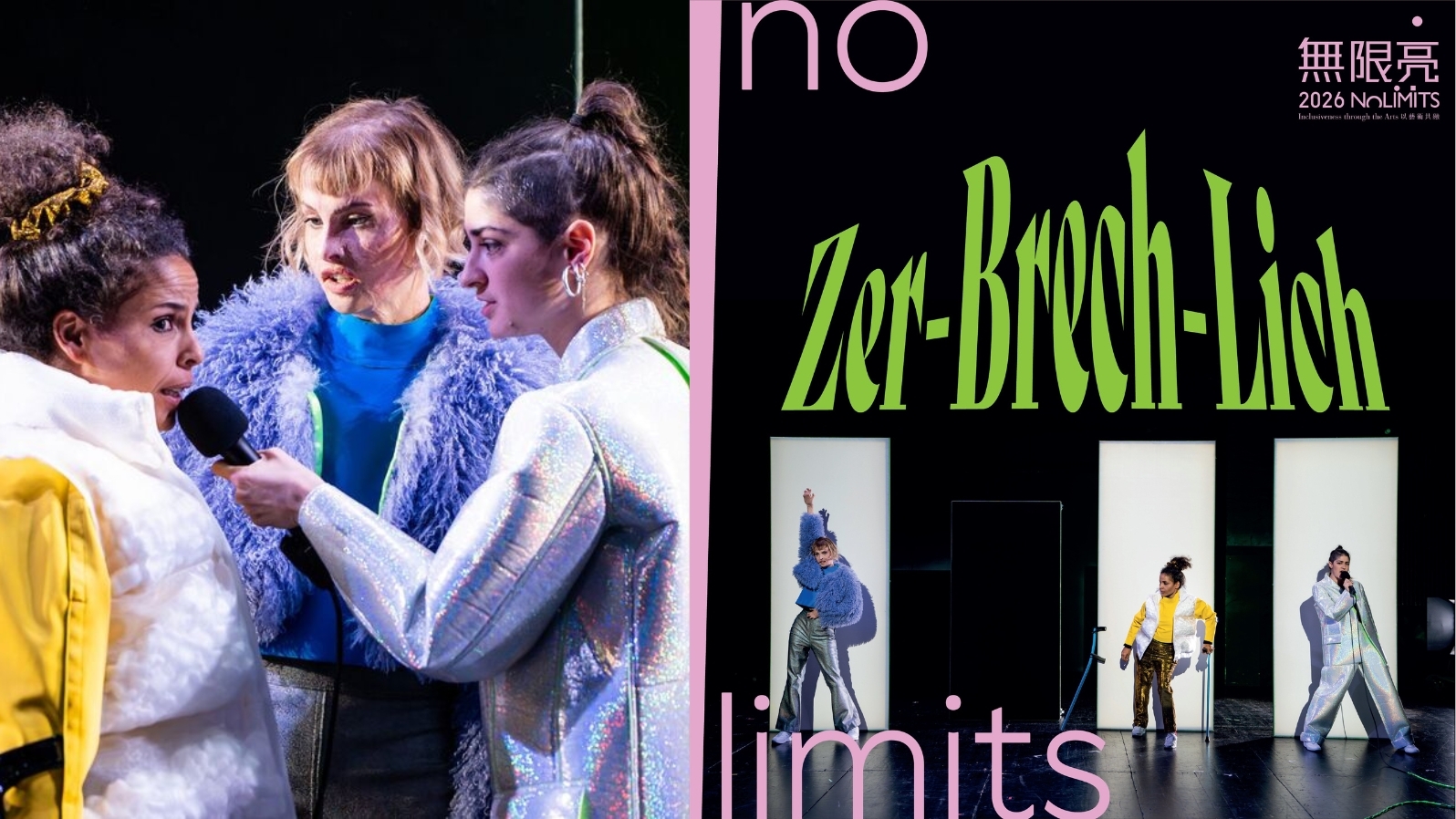
Zer-Brech-Lich: Weaving Vulnerability into Power

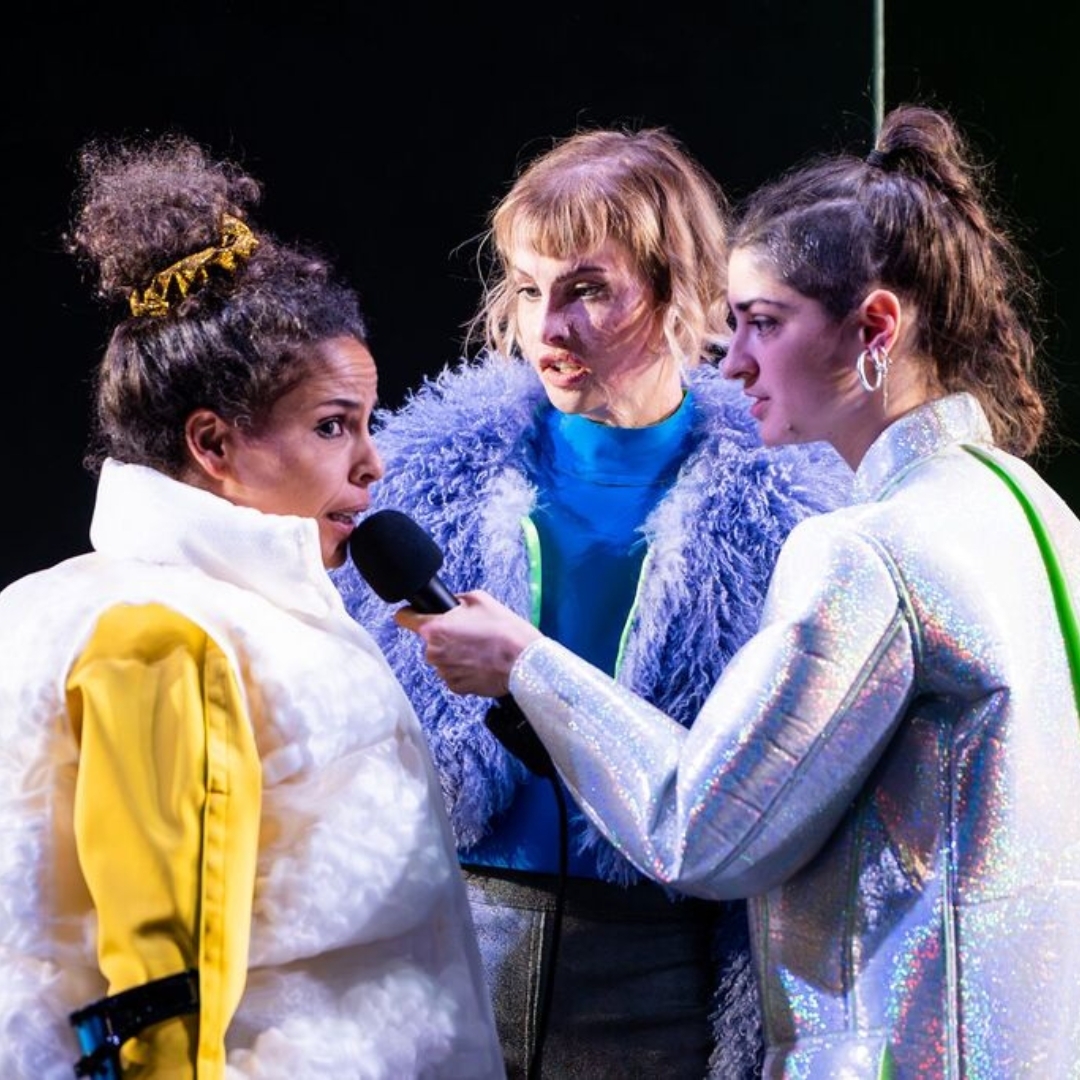
As stage lights dim, a quiet tension settles over the Black Box Theatre at Kwai Tsing Theatre in Hong Kong. Three women glide into view: Alice Giuliani, Victoria Antonova, and Laila White, each carrying the weight and grace of bodies that society has often labeled "fragile."
Yet as they begin to dance, speak, and weave through Gina Été's haunting songs, something in the air shifts. A cup teeters but doesn't shatter; a moment of near-tumble becomes shared balance; laughter punctuates vulnerability. This is Zer-Brech-Lich, the Asia premiere of a work that refuses to treat fragility as a flaw to overcome, instead asking, "What if fragility is the very source of connection, power, and change?"
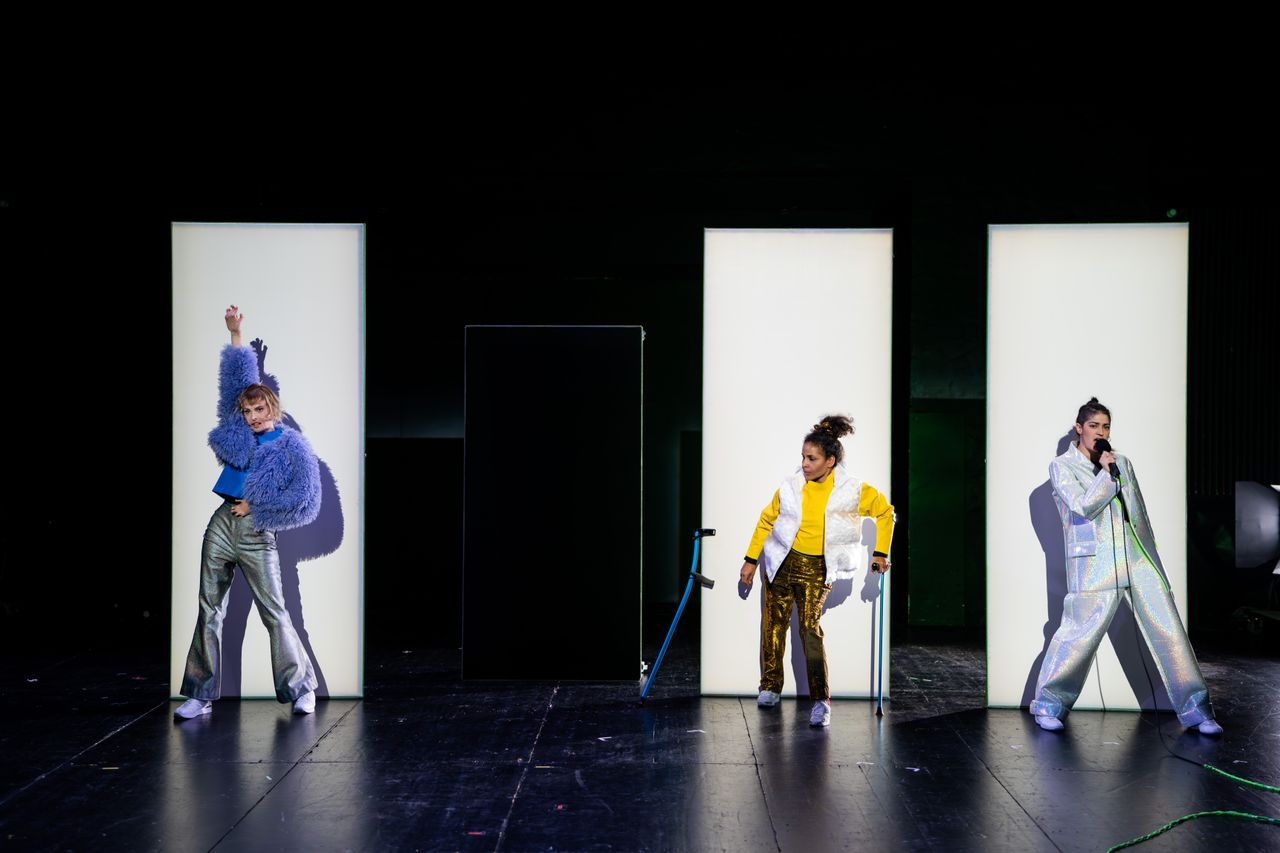
Photo credits: Clemens Heidrich
The Spark of Fragility
The title derives from the German word for "fragile," yet the piece reclaims it. "Initially, it was the gap between how the word is commonly understood and how it is actually lived that drew me to fragility," explains Alessandro Schiattarella, the Italian-born, Swiss-based choreographer and director who conceived the work. "Fragility is often treated as something that needs to be fixed or hidden, but I experience it as a state that sharpens perception and creates new forms of intelligence and adaptability." Alessandro, who has lived with Hirayama disease since age fifteen, a condition that affects hand strength and mobility, brings his own embodied perspective to the project. In Zer-Brech-Lich, fragility is not opposed to resilience. It is its essence. "The strength that emerges in the piece does not come from overcoming fragility, but from engaging with it, navigating it, and allowing it to transform relationships, time, and attention."
The project began almost by accident. Commissioned as part of a collaboration between the Festival Theaterformen, the Staatstheater Hannover, and the Music Academy of Hamburg, the initial spark was simple and serendipitous. "During a brainstorming phone call, I noticed a drawing on my desk that made me think about fragility," Alessandro recalls. "The topic had already been resonating with me on a deeper level, both personally and artistically."
What followed was an extended exploration of how bodies are valued, protected, or exposed in performance. The ensemble formed organically through prior collaborations and mutual trust, shaped by listening, trial and error, and the unique qualities of the performers themselves. "Rather than imposing a fixed concept from the outset, the work was shaped through listening... It was only later that the conceptual framework fully crystallised, revealing fragility not as a theme to illustrate, but as a condition to work from," Alessandro explains.
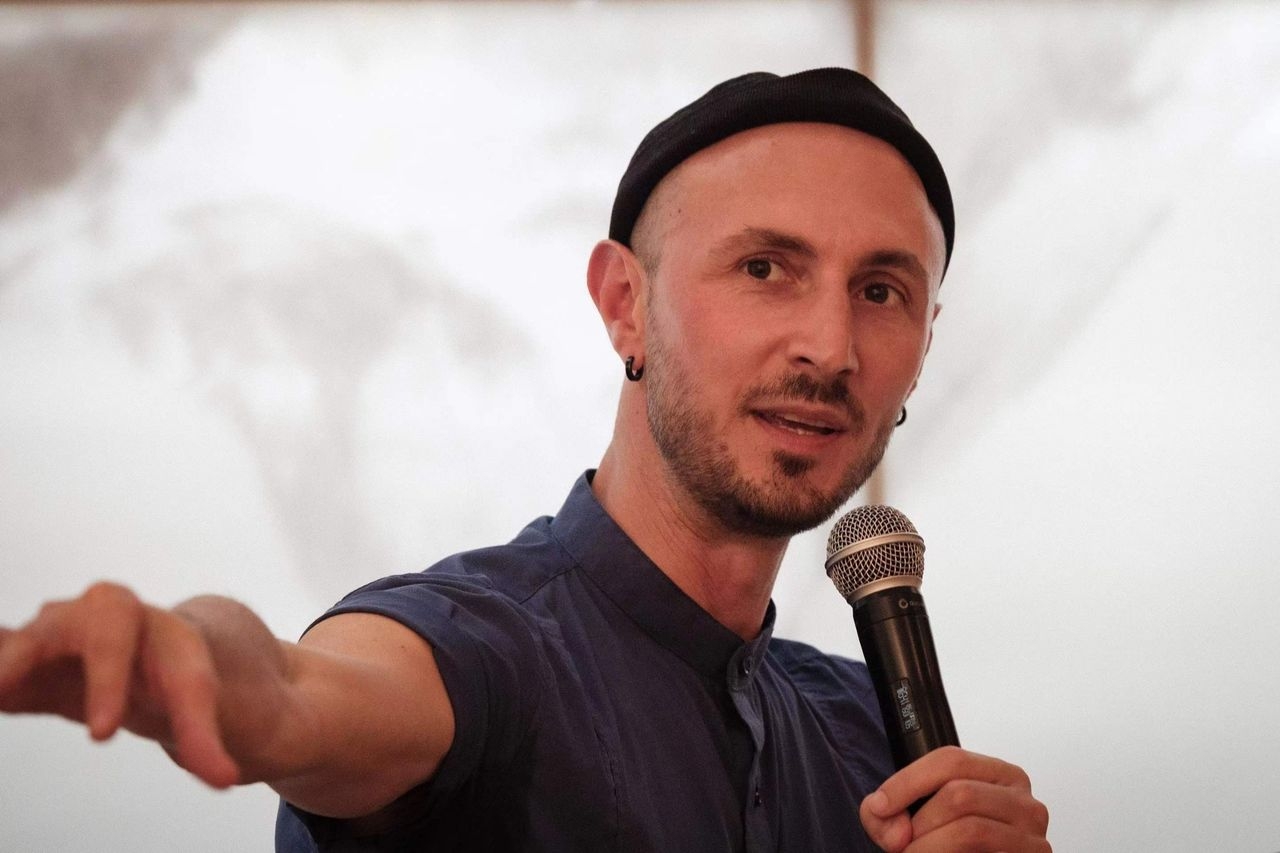
Alessandro Schiattarella
Photo credits: No Limits
Three Bodies, One Stage
At the heart of the 75-minute piece are the three performers: Alice Giuliani, Victoria Antonova, and Laila White, each bringing lived experience as disabled artists to infuse the work with authenticity and depth. The performance blends dance, spoken word, and original songs by Swiss musician Gina Été, creating a multi-layered language that refuses to rely on any single mode. "The combination of dance, spoken word, and music came from a desire not to rely on a single language," Alessandro explains. "Each element carries a different kind of knowledge and emotion, and together they allow fragility to be experienced physically and emotionally, rather than explained or illustrated."
For Victoria Antonova, the fact that the piece featured three women with different disabilities became a strong point of connection and motivation. "We wanted to share, explore, and bring the theme of fragility to the stage, yet on a powerful way," she explains. "That sense of power lies in how we speak about ourselves, how we describe our experiences and how we stand in front of an audience while fully owning our agency and taking up space. When fragility is accepted and embraced rather than hidden, it can exist without shame and becomes a source of strength."
Beyond Movement
The collaboration with Été was serendipitous in its own right. Alessandro initially invited another musician, but when her pregnancy timeline conflicted, he turned to Été, who had four songs nearly ready. "They immediately resonated with the core of the piece, and it felt like a very natural fit." The team rewrote and adapted the songs together, treating the music "almost like choreography or like a garment": fitted, reshaped, and integrated into the performance. On stage, Été's voice becomes another presence: intimate, ironic, emotionally charged, sometimes supporting the action, sometimes contrasting it, its meaning constantly shifting.
Care and mutual support are structural necessities in Zer-Brech-Lich. "We always began with check-ins, and sometimes check-outs, to regulate our energy in the most supportive and productive way," Victoria shares. "There was a lot of talking and sharing that create the space for listening, understanding, therefore care and mutual support for each other." "The process required trust, attentiveness, and the ability to adjust continuously to one another," Alessandro notes. "Mutual support became a shared practice rather than a theme." In performance, this support lingers even when invisible, creating safety that allows risk, playfulness, and vulnerability to coexist.
The creative process challenged assumptions at every turn. "One of the most meaningful aspects has been learning to let go of assumptions about efficiency, clarity, or productivity," Alessandro reflects. "Differences in ability, experience, and perception constantly challenged habitual working methods. Surprises often came from moments of slowness or apparent difficulty, which opened unexpected creative possibilities." These moments reshaped the material and deepened how the team listened to one another.
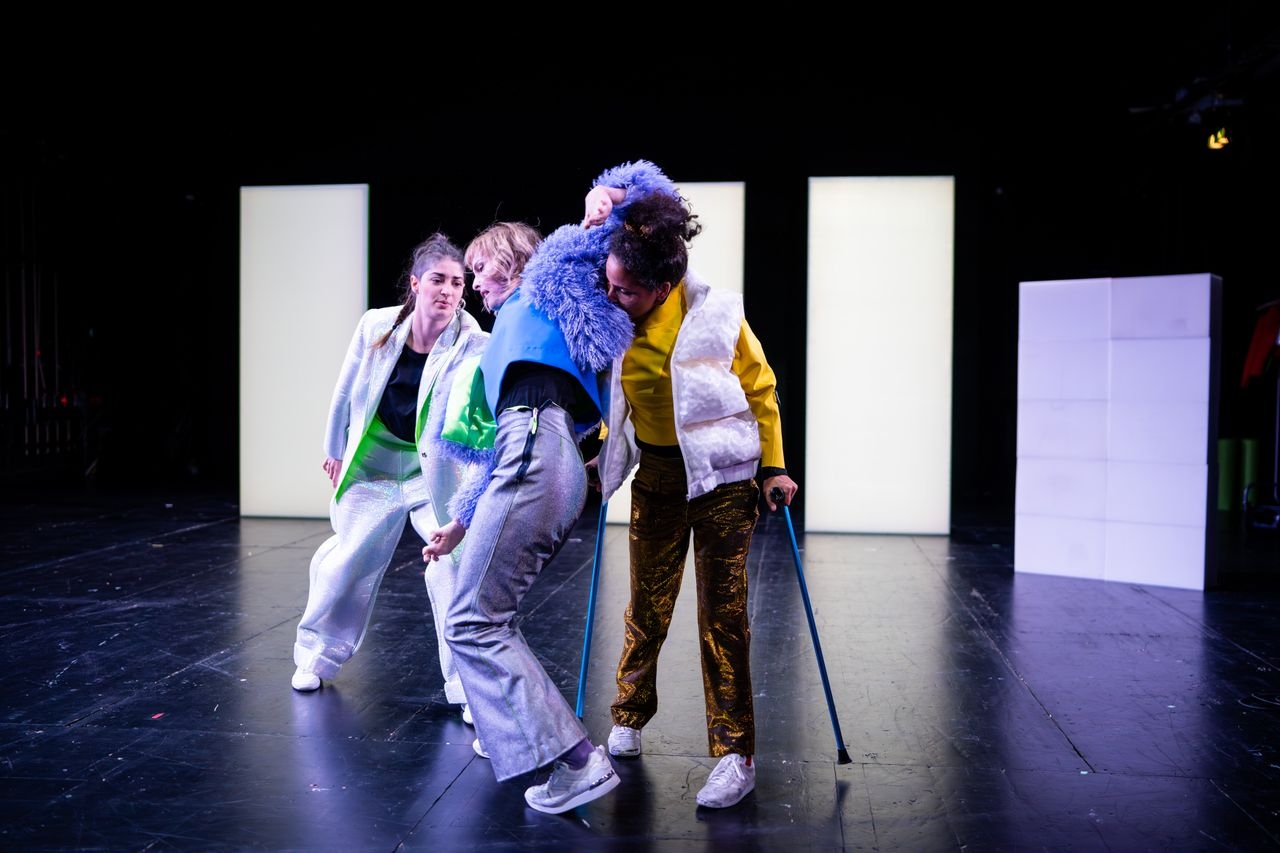
Photo credits: Clemens Heidrich
Redefining Norms Onstage
The piece confronts norms of beauty, strength, and success through playful deconstruction: constructing and dismantling images, sets, and illusions to reveal the mechanisms behind societal expectations. "The work reinforced my belief that beauty can exist in instability, that strength does not need to be spectacular, and that success does not have to align with visibility or perfection," Alessandro says. For Victoria, it highlighted visibility: "Performing this show made visible why our presence matters and why it is important to challenge these ideas."
For audiences, the hope is subtle resonance. "I hope audiences leave with a heightened sensitivity rather than a clear conclusion," Alessandro shares. "Perhaps with a sense of permission to sit with uncertainty, tenderness, or contradiction. If the work opens a small crack in how fragility is perceived, allowing it to be seen as something shared rather than isolating, then it has done its work."
For newcomers to inclusive art, Victoria hopes they will "feel closer to their own vulnerability and to see fragility as something shared, rather than something to be hidden, pitied, or fixed. Ideally, they leave the performance with more openness and more questions." The work is not a specialized category or explanation of disability, Alessandro emphasizes, but "an invitation into a shared human terrain" that shifts perception toward presence, difference, and interdependence.
For those new to inclusive or disability-centered art, the invitation is clear: this is not a specialized category or an explanation of disability. "The work is not an explanation of disability, but an invitation into a shared human terrain," Alessandro emphasizes. "Ideally, the experience shifts perception, even subtly, toward a broader understanding of presence, difference, and interdependence."
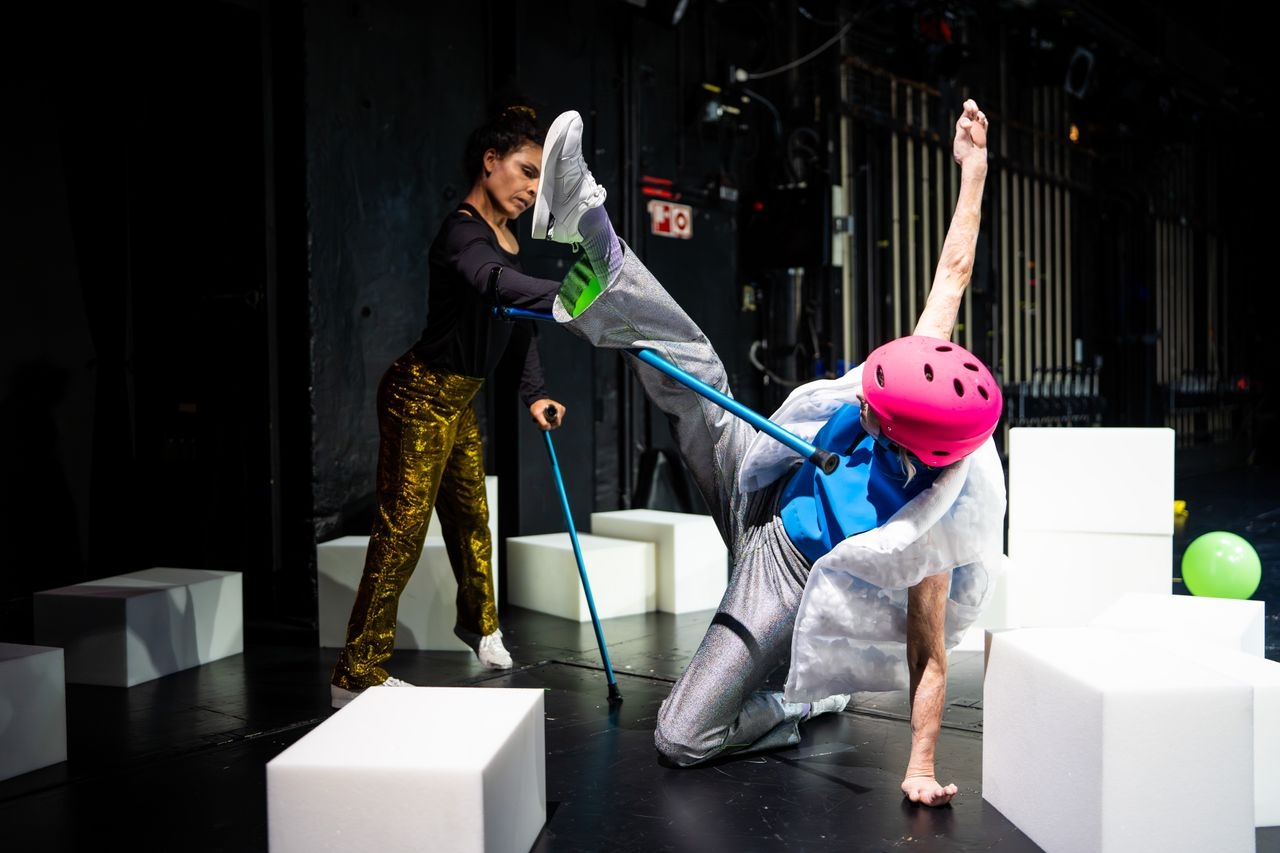
Photo credits: Clemens Heidrich
A Structure That Breathes
The ensemble's balance of structure and freedom proved empowering. For Alessandro, directing provided "a clear and supportive framework in which others can explore, take risks, and unite through creativity," allowing leadership and responsibility to circulate without rigid hierarchies. This strengthened his belief in non-hierarchical collaboration. For Victoria, "This show has a structure, but also a lot of freedom within itself, and that balance has really empowered me... Being in a space where everything is welcomed and can be adjusted to our needs made me feel seen, supported... That is a structure that seems to be more sustainable and allows me to grow both as an artist and as a person."
The Asia premiere in Hong Kong, presented by No Limits and co-presented by the Hong Kong Arts Festival and The Hong Kong Jockey Club Charities Trust, aligns seamlessly with the work's values. "It feels almost unbelievable that we've come this far, and I'm incredibly excited to share the work in Hong Kong," Victoria says. "Accessibility here is not treated as an add-on, but as an integral part of how art is shared and received," Alessandro adds. Features include relaxed performances, subtitles in Chinese and English, audio description in Cantonese, and concessions for people with disabilities.
Perhaps what is most striking is fragility's power to create space for dialogue. "What I love most is how sharing our fragility has opened dialogue and how embracing these qualities can be a real source of strength and connection," Victoria observes. Audiences, presenters, and artists engage from diverse positions yet often reach shared recognition. "If the piece has contributed to reframing fragility as a space of agency, connection, and quiet power, then that is its most meaningful impact," Alessandro adds.
In a world quick to hide cracks, Zer-Brech-Lich lingers on them. It reminds us that true strength is not in pretending invincibility, but in the shared act of holding one another steady when things threaten to crumble.
About No Limits: Illuminating Inclusion
Launched in 2019 and co-presented by the Hong Kong Arts Festival and The Hong Kong Jockey Club Charities Trust, No Limits offers barrier-free performances and events while exploring and promoting inclusiveness and understanding through the arts. The 2026 edition, themed "All of Us, All Ways," features a diverse lineup of music, dance, theatre, and film by international and Hong Kong artists of varying abilities, including the Asia premiere of Zer-Brech-Lich, alongside accessible in-venue shows, free film screenings, a symposium, and education/community programmes. Accessible services ensure enjoyment for all audiences, underscoring the importance of inclusion across life. The programme opens on 27 February 2026. For more details, go to https://www.nolimits.hk/